
Love at First Sight
A wide variety of sources can shed light on a family history. In the case of Andreas Rumling, his entry in the ‘Stamboek van Onderofficieren en Schepelingen van de Zeedienst‘ (Register of Non-Commissioned Officers and Sailors of the Navy) turned out to be the missing link.
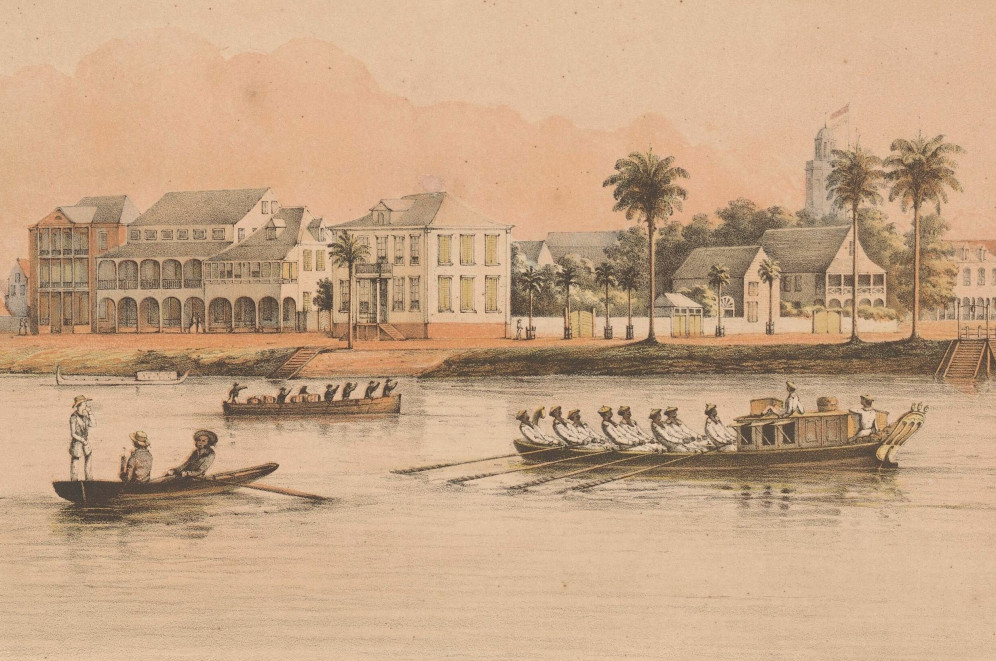
On January 7, 1879, Second-Class Engineer Andreas Rumling is at the Government House in Paramaribo. Like the other (non-commissioned) officers of the screw steamer Aruba, he has been invited to the reception in honour of the wedding of King Willem III and Emma of Waldeck-Pyrmont. Is this where Andreas, wearing his gala uniform, sweeps the 19-year-old Caroline Mary Kennedy off her feet? Whatever the case may be, a year later the two are married in Paramaribo, just before Andreas sails for the Netherlands.
Third-Class Engineer
Andreas, born in Amsterdam in 1841, is the thirteenth child of Bernd Henrich Römling—or Rumling, as he calls himself after settling in the Netherlands— originally from Steinfurt, Germany, and Anna Maria Elisabeth Burger from Amsterdam. In 1860, the nineteen-year-old Andreas is recorded on the militia register, with ‘blacksmith’ listed as his occupation. He is declared fit for service and assigned to the infantry for five years.
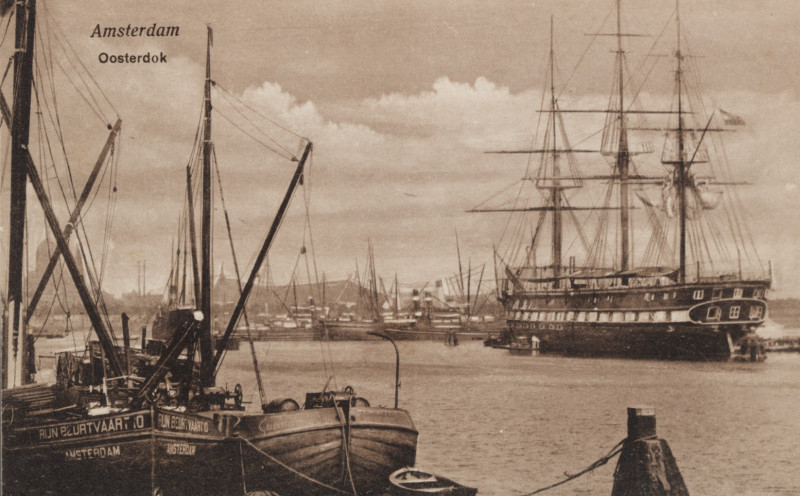
In June 1868, Andreas appears as a third-class engineer in the navy. Initially, his permanent posting is on the guard ship in Amsterdam, but as early as January 1869, Andreas is deployed to the former Dutch East Indies, where he will remain for over four years. There, among other things, he takes part in the military expeditions around Balangnipa (South Celebes) against the notorious ‘rebel’ Kraeng Bonto Bonto.
After returning to the Netherlands, Andreas is stationed alternately on the guard ship in Amsterdam and at Willemsoord. Three years later, he sets sail for the West Indies aboard the Aruba. After travelling along the west coast of Africa, on July 11, 1876, the ship reaches Paramaribo, where Andreas will meet Caroline Mary Kennedy in 1879.
A Prominent Family
The Kennedy family has lived in Paramaribo since the mid-18th century and owns and manages several plantations. Caroline Mary (1859–1940) is the ninth child of Archibald Henry Francis John Kennedy and Johanna Monroy. Her three eldest brothers were only recognized and legitimised in 1846, when their parents were married. In the Paramaribo district registers, a checkmark appears next to Archibald’s name in the ‘whites’ column, but for Johanna and their children, the checkmark is in the adjacent column: ‘people of color’.
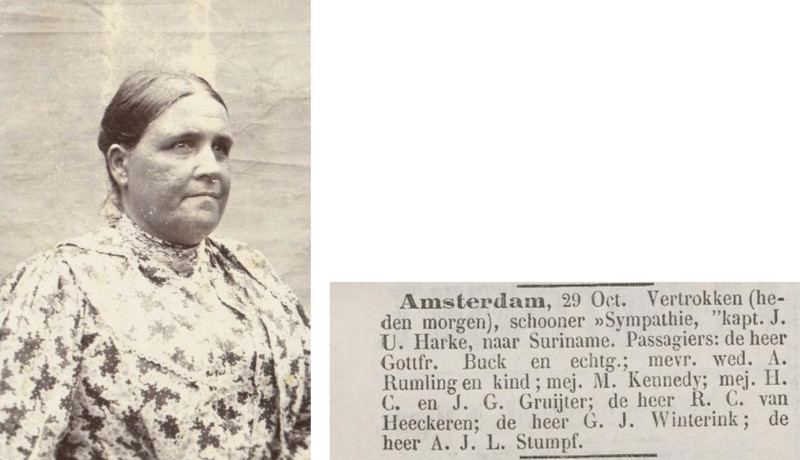
A year after their first meeting, Andreas and Caroline get married in Paramaribo on February 11, 1880. However, they won’t enjoy their honeymoon for long; less than a month after the wedding, Andreas sails for the Netherlands aboard the Marnix. Caroline follows her husband three months later aboard the Cornelia & Geertruida. By then, she is already pregnant with their first child. In Amsterdam, Caroline first finds accommodation on the Prinsengracht, but eight months later she moves to the Haarlemmerstraat.
Disaster and Flight
Sometime between Andreas’ departure from Paramaribo and November 1880, an accident occurs while he is at work: he breaks his left arm and hand. In March 1881, Andreas is declared completely unfit for duty ‘due to physical impairments arising from and caused by his duties’. He has lost all functionality in his arm and hand, to such an extent that ‘this condition must be considered equivalent to the loss of the limb’. Effective April 1, he is granted a supplementary pension due to his permanent disability. To make matters worse, Caroline gives birth to a stillborn son during his illness.
In May 1882, Caroline’s mother Johanna, her sister Dorothea, and their nephew Archibald join them from Suriname. Three months later, the five of them move into the newly completed building at Nassaukade 15. Their daughter Johanna Elizabeth is born there on October 21. Hopefully, Johanna had a chance to take her granddaughter in her arms, because exactly one week after the birth, she died from the complications of an incarcerated hernia. Seven months later, on May 31, 1883, Andreas also passed away. The cause of death register indicates that he died of bronchopneumonia and paralysis pulmonum—a paralysis of the lungs resulting from pneumonia.
Caroline, 23, is left to fend for herself: in less than three years’ time, she married, moved to an unfamiliar country, her husband was involved in an accident, she gave birth to one stillborn and one living child, and she lost both her mother and husband. She packs her bags and travels back to Suriname with her baby and her sister. It wouldn’t be until 1929 that she would return to the Netherlands with her daughter to settle there permanently.